
It's officially the off-season. Race season is over and it's time to relax and soak in this year's hard work, right? Wrong. The off-season is a crucial part of the year, and if you're just sitting around eating turkey and cookies, you're going to be in trouble come race season.
So here's how Kilian Jornet says you should train during your off-season, from his book and my bible, Training for the Uphill Athlete.
Rather watch? This whole plan is in the video above, and there's more on my YouTube channel.
Why train in the off-season?
In the book, Kilian has a 100 mile training plan that's 48 weeks long, so basically a year. That's how long you should really be training for a 100 miler. Sixteen weeks will maybe get you to the finish line, but if you want to do well in your race, it's a year.
That's why I made the aerobic base building training plan. It's based on the base building period in Kilian's 100 mile plan, where about 90% of your runs are in Zone 2, or Zone 1 if you're very aerobically fit. It's meant to go right before your race-specific plan, like my 50k, 50 mile, 100k and 100 mile plans, so you're aerobically fit before you jump into the 16 weeks.
The off-season plan is basically the same as the aerobic base plan, with a little twist: I added strength training and trimmed a bit of mileage off the long runs.
Use it during your off-season. For most people that's winter, but if you race in the winter, move it to any time of the year when you're not preparing for a race.
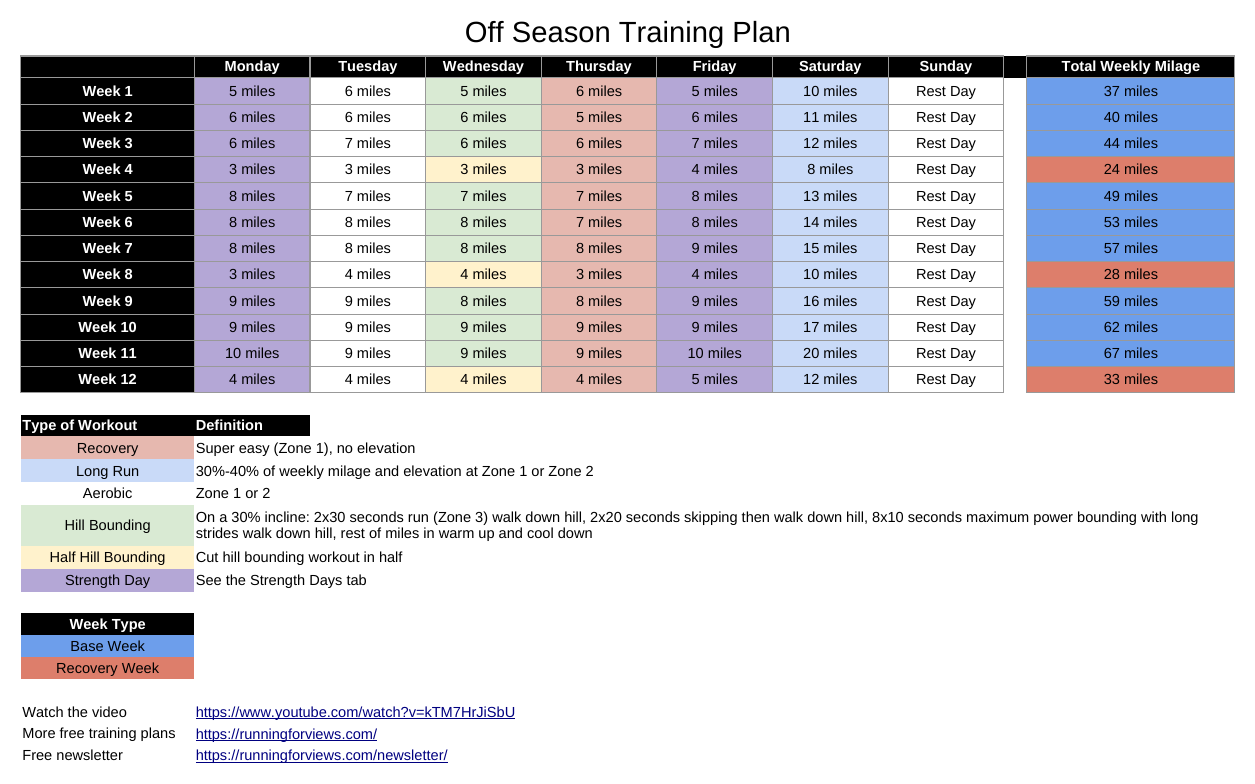
The plan
Strength days: Monday and Friday
Mondays and Fridays are strength days. You run that day's normal mileage at aerobic pace (for example, Monday's 5 miles), and you also do a strength block.
The strength workouts are on the second page of the plan. It looks like a lot of words, but I promise it's not as confusing as it looks. Do it two times per week. I put it on Monday and Friday, but you can do it on your workout day, your recovery day, whatever is easiest, as long as it's twice a week.
- Warm up. Either the run you did that day, or the active stretching from my hill bounding video.
- Core workout. There's a beginner (green), intermediate (yellow) and advanced (red) section. Pick the one that fits your strength level. For example, the beginner core workout is knee planks, 6 x 15 seconds with 1 minute rest between sets, and windshield wipers (legs up in the air, moving them side to side to touch the floor on each side), 6 max reps with 1 minute rest between sets.
- General strength workout. Stick with the same level as your core workout. The beginner workout is four exercises done back to back with no rest: squats with a knee band (booty band) for 20 reps, incline push-ups for max reps, single leg lateral band walks for 20 reps per leg, and incline push-ups for max reps. Then rest 2 minutes, and do the whole circuit 4 times.
After four rounds, you're done with strength for the day. If you're not sure what an exercise looks like, the book has them all (or you can just Google it, but buy the book).
As the weeks go on, move up from beginner to intermediate to advanced. Once you're at advanced, keep progressing by adding weight.
The running
The rest of the plan is just like the aerobic base plan: three building weeks and then a recovery week, three times over. The difference is the long runs. Instead of building up to a 26 mile long run, you build up to 20 miles.
That way, when your off-season is done, you're ready to hop straight into the aerobic base building plan, and then into your race-specific plan.
If you have any questions, or if you want me to do a follow-along video of the strength exercises, let me know in the comments on the video. For more plans, subscribe on YouTube.