
You guys have been loving the training plans I've been putting out about how to train like Kilian Jornet, so here's another one from Kilian's book, Training for the Uphill Athlete. This book is literally my training bible, and if you don't have a copy yet, you need to get one.
Today it's how to build your aerobic base like Kilian, the GOAT himself. This is the 12 week plan to do before your race-specific plan.
Rather watch? This whole plan is in the video above, and there's more on my YouTube channel.
What is aerobic base building?
To put it simply, it means running in Zone 1 or Zone 2 of your heart rate zones on a five zone model.
To put it complicatedly: aerobic base is the physiological state an athlete reaches through lots of training at low to moderate intensities. Look at any professional athlete, ultra runners or mile runners, and they do most of their training at low to moderate intensity. Aerobic training helps your muscles produce energy aerobically, using fat as the main fuel. It makes up the vast majority of an endurance athlete's yearly training, and it helps you recover faster from hard training and races.
An easy way to remember it is the 80/20 rule: 80% of your workouts in Zones 1 and 2, and the other 20% in Zones 3, 4 and 5.
The base period
The base period is when you focus on building your aerobic capacity. That's the foundation that gets you ready for your A goal, whether it's 100 miles or one mile.
In my 100 mile training plan I talked about how I already had a good base going into the 16 week program. This plan is the base building period from The Uphill Athlete, and it gets you ready for my 16 week plans for the 50k, 100k and 100 mile.
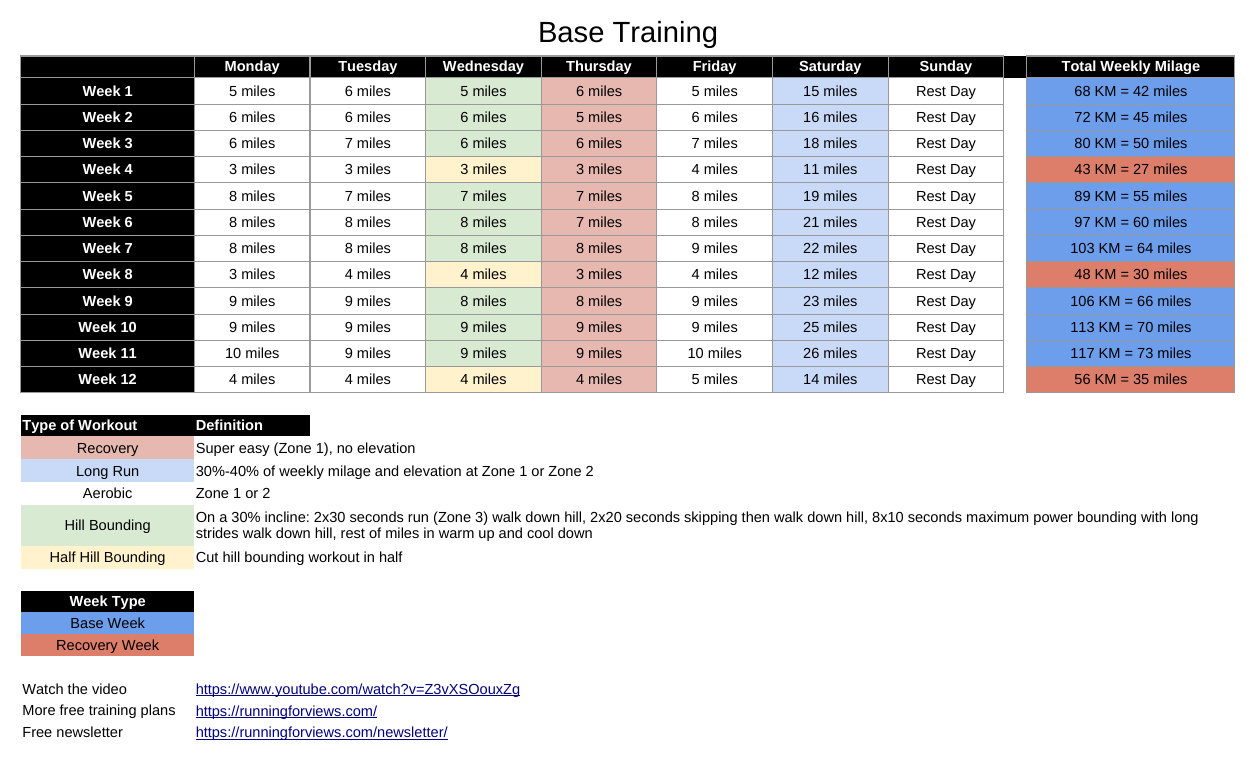
Weeks 1-3: Base weeks
These first weeks build your aerobic base from the ground up.
Monday and Tuesday are aerobic days, staying in Zones 1 and 2. The book says 85% of your training should be in Zone 1 and only 15% in Zone 2. But if you're just starting to build your base, it's best to just stay in Zone 2, because even that can be very difficult at first. I use a heart rate zone alarm that alerts me when I switch zones. Most newer watches have one (here's how to set it up on an Apple Watch). If yours doesn't, just keep an eye on your zones while you run.
Wednesday is workout Wednesday: hill bounding. This is one of Kilian's favorite exercises. I have a full video on it on my channel because it's a little complicated, but here's the basic idea:
- Warm up for 20 minutes, then stretch for 10 minutes.
- Find a really steep hill, about a 30% incline. Do 2 x 30 second runs at a medium to hard pace, walking down with 2 minutes rest between reps.
- Do 2 x 20 seconds of hill skipping, walking down with 2 minutes rest between reps.
- Do 6 to 8 x 10 second hill bounds with maximum power and long strides, walking down and resting 1 to 2 minutes.
Then do the rest of your miles for the day as a warm up and cool down.
Thursday is a recovery day: super easy, Zone 1 or low Zone 2.
Friday is another aerobic day, and Saturday is the long run, about 30 to 40% of your weekly mileage and elevation, in Zone 1 or 2.
Sunday is a rest day. Relax, maybe eat a little more, go for a walk. You know how to rest.
You follow that schedule for three weeks.
Vert: aim for a third to half of your goal race's elevation every week. For example, if you're training for a 100 miler with 24,000 feet of gain like the race I did, that's anywhere from about 7,200 to 12,000 feet per week during this base period.
Week 4: Recovery week
Cut your miles in half and your vert in half. It's the same layout, aerobic days, hill bounding (cut in half), a recovery day, an aerobic day, a long run and a rest day, just a lot less of it.
Weeks 5-12
Weeks 5 through 12 repeat weeks 1 through 4: three base weeks and one recovery week, two more times, with the mileage building each block.
That wraps up the 12 week aerobic base building plan. Not too difficult, right? Once you've done it, you're ready for your race-specific plan, or my off-season training plan if race season is over.
If you have any questions, leave them in the comments on the video and I'll answer them there. For more plans, subscribe on YouTube.