
You guys asked for it, so here it is: the advanced 100 mile training plan.
Running 100 miles is no joke. This plan is for people who have already run a few hundreds, have a good feel for them, and are ready to take their training to the next level and train like the pros. It's for people who want to finish their 100 mile race knowing they did everything in their power in training to get to that finish line as fast as possible.
This is a very difficult plan. I've also made a beginner 100 mile training plan and an intermediate 100 mile training plan, so if you're not an advanced runner, stick to one of those.
Rather watch? This whole plan is in the video above, and there's more on my YouTube channel.
Advanced 100 Mile Training Plan
As always, this plan follows the teachings from Kilian Jornet's book, Training for the Uphill Athlete. It's the ultra running bible. I very strongly suggest you get it. On top of that, this plan uses methods from other pros and coaches like Jim Walmsley and the Some Work, All Play podcast.
What sets this plan apart from the beginner and intermediate plans is that it includes strength, more speed, more miles, and a few other updates I think you'll really like.
It's a 16 week training block. Before you start, I suggest following my aerobic base building training plan. It will get your aerobic capacity up and prepare you for the mileage in this plan. The base plan ends with a 73 mile week and then a recovery week, so if you hop straight into this plan after it, you'll be perfect.
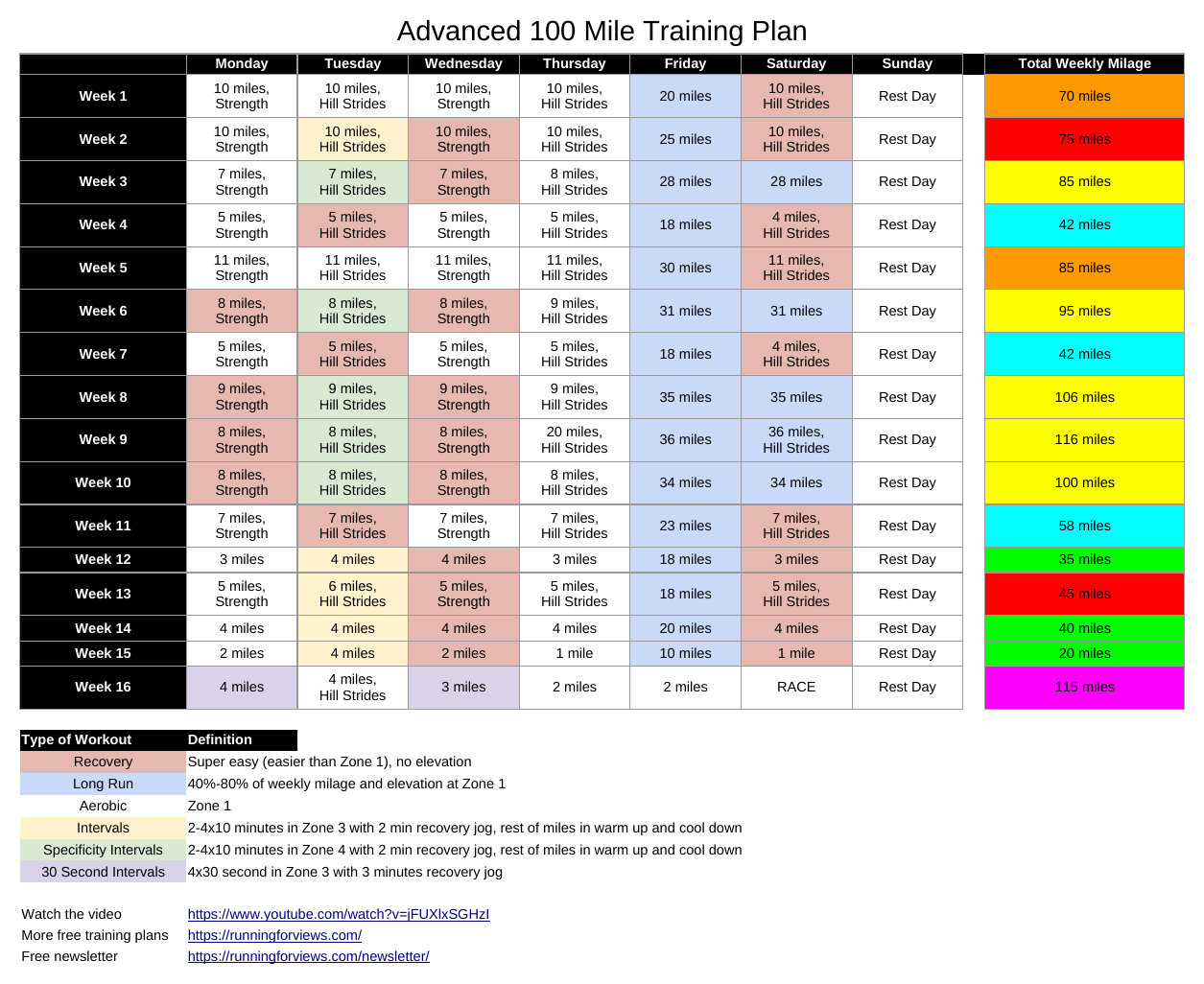
Week 1: Base week
A base week means all of your running is in Zone 2, except recovery runs, which are Zone 1 to low Zone 2. On base weeks, do about 50% of your race's elevation. So if your race has 30,000 feet of gain, you do 15,000 feet over the week.
We're coming in hot with a 70 mile week, so keep that in mind before you start.
Monday is an aerobic day in Zone 2, plus strength. The strength tab in the plan has three levels:
- Beginner (green): for people who haven't done any strength training.
- Intermediate (yellow): for people who have a bit of a grasp of strength training.
- Advanced (red): for people who have been using weights.
If you're new to strength, do four weeks of beginner, then four weeks of intermediate, then four weeks of advanced.
Tuesday is another aerobic day with hill strides. Find a hill with about an 8% grade and do 6 to 10 x 30 seconds up it in Zone 4. This isn't an all-out sprint. It's a controlled effort with quick steps. Jog back down to the bottom and go again. Do these at the end of your run and you'll see massive aerobic gains.
Friday is the long run. You can do your long run on any day, as long as it's at least 48 hours after your speed workout. Do 40 to 80% of your weekly vert on your long runs at a Zone 2 pace. For a race with 30,000 feet of gain, that's about 6,000 to 12,000 feet.
Run the downhills on your long runs hard. On my normal runs I let myself slip into Zone 1 on the downhills and let the mountain carry me down. On long runs, stay in Zone 2 to mid Zone 2 and stay quick on your feet. You need that downhill stimulus for these long races.
Sunday is a rest day. Take it completely off. No cross training, no quick little jog. Just chill.
Week 2: Intensity week
An intensity week is a base week with a speed day, and about 40% of your race's elevation instead of 50%.
Tuesday is intervals: 4 to 6 x 10 minutes in Zone 3 with a 2 minute recovery jog between reps. Any extra miles for the day can go into a warm up and cool down, or a separate run earlier in the day.
Week 3: Specificity week
My favorite weeks. This is when the training gets hard.
On specificity weeks, run on terrain like your race. If your race has super technical trails, run technical trails. If it's flowy and easy, mimic that. Do 60 to 110% of your race's elevation: keep it at 60% for the first two specificity weeks, then 90 to 110% in the three week specificity block later in the plan.
The intervals move up to Zone 4. No more Zone 3.
On the weekend you have back-to-back long runs, with 60 to 80% of your weekly elevation across those two days. With the 30,000 foot race example, that's about 18,000 feet for the week, and 10,800 feet over the two long runs: 5,400 feet one day and 5,400 the next. If you want to know why all the best ultra runners do back-to-backs, I made a whole video about it on my channel.
Week 4: Recovery week
Take it super easy. Stay in low Zone 2 to Zone 1 and only do about 25% of your race's vert. If you're hurting or feel a niggle coming on, take days off as needed, or swap a day for cross training if your legs are super fatigued.
It's basically a base week with a recovery day added. And on every recovery run in this plan, stay in low Zone 2 to Zone 1 with very minimal vert.
Weeks 5-7
These repeat the weeks we've already covered. If you have any questions so far, leave them in the comments on the video and I'll answer them there.
Weeks 8-10: The specificity block
These are the weeks that make this plan different, and very difficult. This is where I mesh together the training of the two greatest ultra runners we have, Kilian Jornet and Jim Walmsley.
To train for his goal races, Jim does back-to-back-to-back long runs, and that's what we're adding in one of these three weeks.
In this block you do 90 to 110% of your race's elevation. A great way to get it is to run on your actual race course. Try completing the full course, or part of it, over 3 to 4 days, or however many days you have. If you can't get to the course, mimic its elevation. If your race has six 3,000 foot peaks, try to do that in your training.
Do about 80% of your weekly elevation on the back-to-back long runs: 40% one day and 40% the next.
Weeks 11-15: Taper weeks
Taper weeks are like recovery weeks with about 25% of your race's elevation, but you keep the speed day. No hill strides and no strength in the taper weeks. They're meant to wind down your training and get you focused on your race. There's also one intensity week in here to keep a little pep in your step.
Week 16: Race week
Race week, baby! Don't spend too much time on your feet. Rest and make sure your muscles are fresh for race day.
Monday and Wednesday have 30 second intervals: 4 x 30 seconds in Zone 3 with a 3 minute recovery jog between them. This just keeps your muscles sharp and holds on to the speed you built.
Then on the weekend, you have your 100 mile race. You are going to crush it if you followed this plan.
Questions? Leave them in the comments on the video and I'll answer them there. For more plans and trail running videos, subscribe on YouTube.