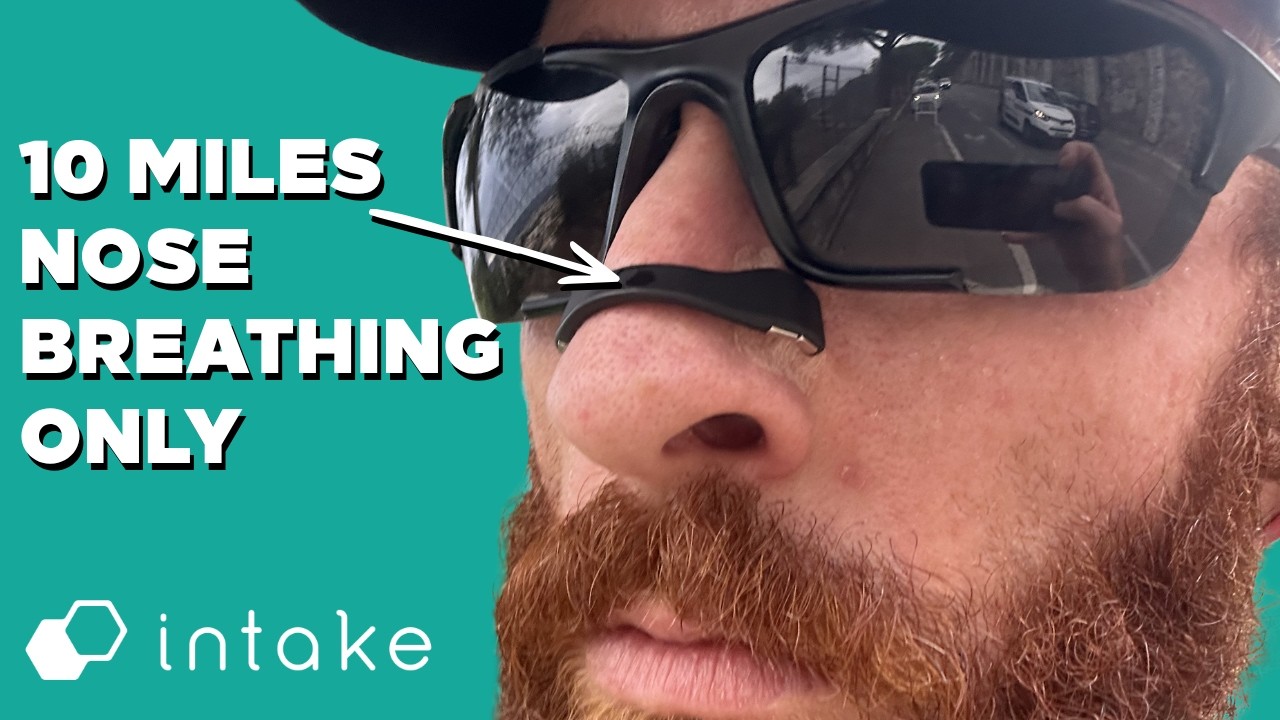
Short answer: for me, yes. With an Intake magnetic nose strip on, I ran 10 miles and 2,000 feet of climbing breathing only through my nose, which I have never been able to do. My hill repeat times were faster with the strip, but my heart rate data was inconclusive, so placebo or not, it helped me. I will use it for hard workouts and races, not every day.
Subscribe on YouTube New videos from the trails, straight to your feed.
Why I tested nose strips
Two things about me make this a real test.
First, I am a heavy sweater. I think I sweat more than pretty much anyone on the planet. If a strip can survive me, it can survive you.
Second, I have a double deviated septum, which means I can't breathe out of either nostril. Regular nose strips have never worked for me. I tried to wear a Breathe Right strip at UTMB and it fell off four minutes after I put it on.
Intake sent me their magnetic nose strips to try. I am not sponsored and I was not paid. The only thing I got out of this is the strips themselves.
Quick facts from my test
- The run: 10 miles, 2,000 feet of climbing, about an hour and a half, breathing only through my nose
- The weather: raining, about 60 degrees, and I was soaked through everything
- Did it stay on? Yes, the whole run. A little lifting on one side, from me touching the adhesive
- Hill repeats (about a 30% grade): 9:04 with the strip, 9:50 without, 9:50 with, 10:10 without
- Peak heart rate: about 177 with the strip, 175 without. Inconclusive
- Would I recommend it? Yes, for workouts and races, after you train with it
10 miles breathing only through my nose
My goal was simple: 10 miles and 2,000 feet of vert, only breathing through my nose. If I could do that and the strip stayed on the whole time, I would be a believer.
At the halfway point, five miles in, it was raining, I was drenched in sweat, and the strip was still holding. No mouth breathing. I have tried all the little nose strips, and this is the only one that has stayed on this long and actually helped me breathe.
Then came the climbing. Without a strip, I think I could maybe nose breathe for a quarter of a mile on a 2% grade. I was going up 20% grades all the way to the top, nose only. To be honest, I did not think it would work, and it worked.
At the end of the 10 miles, an hour and a half with it on my face, it had not fallen off. There was a little lifting on one side, but that was my fault for messing with the adhesive when I put it on.
How to put on Intake nose strips
Here is how I put mine on. Getting this right is what keeps it stuck.
- Clean your nose. Wipe the alcohol wipe across your nose to get all the oil off.
- Dry it completely. Let it dry for a minute. I also dry it with a towel so it is as dry as can be.
- Pick your size. I am a large.
- Stick the tabs on. The two tabs go on the outside of your nose, one on each side. Peel the backing, and do not touch the adhesive with your fingers.
- Rub them down. Tap and rub each tab in so no edges or sides are poking out.
- Snap on the strip. It attaches to the magnets on the tabs, fins up, and opens up your nose.
The strip itself snaps on and off super easily. It is a little harder to get off than on, but when are you going to be taking it off mid-run anyway?
The hill repeat test: strip on vs. strip off

For the second test I wanted numbers. I picked a 0.35 mile segment on Strava, about a 30% grade, half road and half trail, and ran it with the strip on and off to compare my times and heart rate. The plan was six reps. This hill is steep and it hurt my calves, so I got four in.
| Rep | Strip | Time |
|---|---|---|
| 1 | On | 9:04 |
| 2 | Off | 9:50 |
| 3 | On | 9:50 |
| 4 | Off | 10:10 |
Rep 2 felt harder, but it was also my second time up a 30% grade, so it was always going to be slower. On rep 4 I had to walk some, and I don't know if that was the strip being off or just tired legs. It did feel easier with the strip on.
What my heart rate data showed
After looking at the data, it was inconclusive. I was able to reach a higher heart rate with the strip on, about 177 compared to 175 without. Whether that is placebo or not, the strip does help me personally. I can only speak from my own experience, and this is my N of one study.
I also looked through a few science journals, and the research is pretty much the same story: inconclusive. If it feels good, do it. For me, it felt good.
Nose strips are like running poles
I think nose strips are a lot like poles. At first, if you don't know how to use them, they can do more harm than good. People who take poles to UTMB without ever training with them have no idea what to do with them, and they end up tweaking muscles they have never used.
Same with nose strips. My nose is completely off center, and I have never been able to get much air through it until now. I have to train how to use my nose while I'm running. Try these things in training first, then move them into your big workouts and your A race. If you are building toward one, here is my 100 mile training plan.
The biggest race day win: breathing while you fuel
This is where I can really see nose strips coming in handy. In a long race you are taking in water, gels and liquids the whole way. With the strip on, you can keep breathing through your nose while you take a drink or get a gel down.
That means you are never not breathing. You are not gulping air afterward, maybe choking on it or having to take a break. You get more consistent air and can hold a more even pace while you fuel. In a long, long race, that adds up.
Would I recommend nose strips?
Yes. They worked very well for me, and if they stay on someone as sweaty as me, they should work for most people. I just need to do my part and apply them properly.
Would I use them every day? No. I will use them for workouts where I am pushing as hard as I can, for long runs, and you will see me wearing one at any race I run.
If you want to try them, here are my links (I earn a small commission if you buy):
Do you use nose strips in training, only on race day, or not at all? Tell me in the comments on the video, and tell me how you want me to test them next. If you track your heart rate on an Apple Watch, here is how to set up or turn off heart rate zone alerts before your next test.